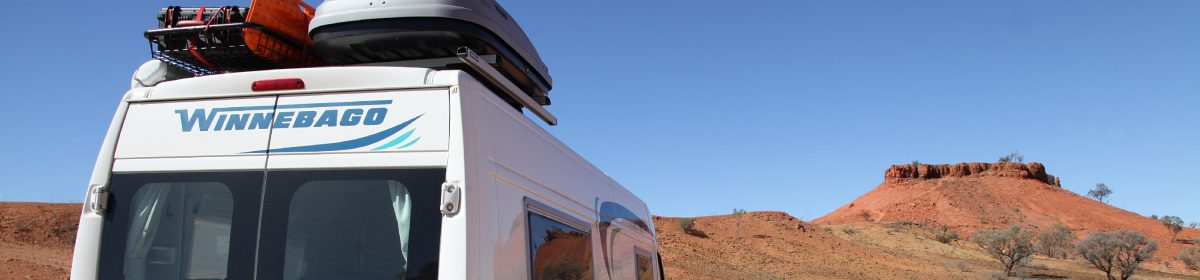
As we left Barn Hill and turned onto the Highway, there was definitely a strange noise coming from the rear axle that was quite worrying. Luckily, we were able to pull straight into a large day rest area. Jonathan took a look and thought it might be a wheel bearing. We had taken out break down cover through Ken Tame which is specifically designed for motorhome travellers and gave them a call. It was decided to send a tow truck and take us back to a mechanic in Broome.
Luckily when you break down in your motorhome, you can have a brew up and lunch while you’re waiting!
As we’ve discovered before, the mechanics in remote places are very resourceful and quick to find the issue. They stripped down the rear hubs and discovered a disintegrated handbrake calliper. They took it out altogether so the van was driveable again but as it was beer O’clock aka closing time, we’re going to head back there in the morning to get the parts ordered.
The good thing about coming back to Broome was that we knew a good place to stay and headed to the Pistol Club again for the night.
On this stretch of coastline, the beach side camps are down unsealed roads off the highway. Barn Hill is 9km down a well graded road and easily accessible to 2WD vehicles. The unpowered sites have the ocean views and are first come, first served. We were lucky enough to get a fabulous spot.
There was a path down to the beach and dogs could run off leash.
The road in
Lots of interesting rock formations
And this bit here is called a ‘stick out’
The boys check out a rocky overhang
Pink mulla mulla
The park laid on plenty of entertainment for travellers with a bowling green being particularly popular with the grey nomads. One of the most popular pastimes was to sit along the back of the vans with drinks and nibbles at sunset and swap travel stories.
There are also plenty of stars when you’re in a remote place.
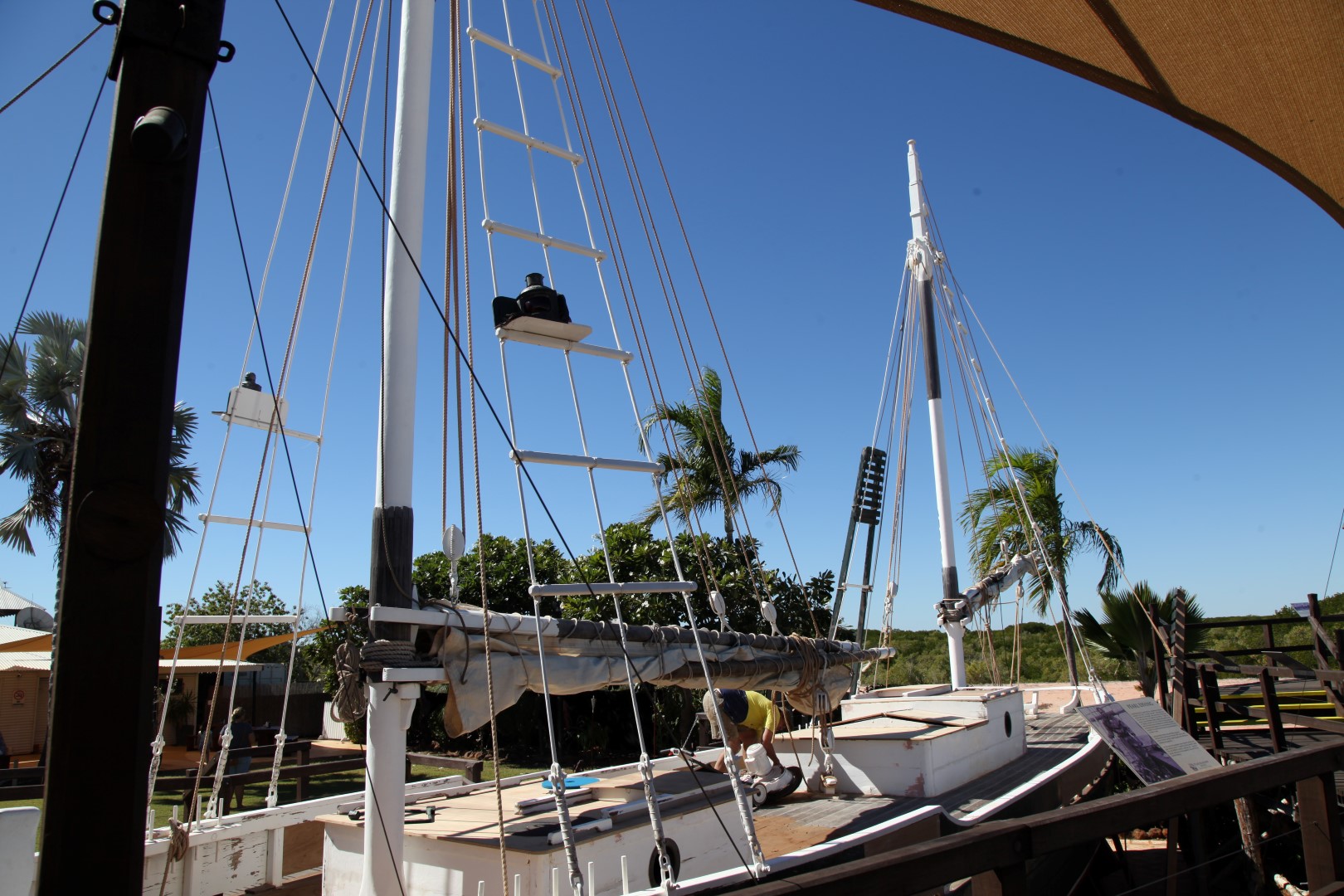
The one hour tour at Pearl Luggers was very informative and given by Rachel, a Geordie lass. A lugger is a small sailing boat with a particular type of sail called a lug sail, and it was these luggers which were used by pearl divers.
The early years of pearl diving in Broome were shameful times as Aboriginals were kidnapped from the West Kimberley by gangs known as ‘blackbirders’. They were drugged and put on the luggers and forced to free dive for the pearl shells. Women who were pregnant were often taken as it was thought they had a better lung capacity. There is a statue to acknowledge these female divers at Roebuck Bay.
With the introduction of diving suits in the 1880s, divers could go deeper and stay under for much longer which increased the amount of pearl shells that could be recovered. This pretty much brought to an end the practise of coercing Aboriginal divers and Japanese divers were mostly employed. It was a highly dangerous occupation. The suits were primitive and many divers suffered from divers’ paralysis (now called ‘the bends’). Many became addicted to opium to deal with the pain. The helmet itself weighed 45kg and if a diver fell over on deck while wearing the helmet it would break his neck.
Pearl shell was highly sought after particularly for making buttons and Broome supplied 80% of the world’s pearl shell. If a pearl was found when cleaning the shells, it was expected to be placed in a P. Percy Box which allowed pearls to be dropped in but not tipped out.
During WWII, every Japanese person in Broome was interned and this was a disaster not only for the pearling industry but for pretty much every industry in Broome. As other materials were developed such as plastic for buttons, the demand for pearl shell decreased.
Broome Shire Council don’t allow pets in any of the caravan parks but they have three sites that are for pet owners only. The oval at Town Beach has no shade and dogs aren’t allowed on Town Beach. The Seventh Day Adventist Church site is a small car park in the middle of nowhere. We decided the best of the three was the Pistol Club which has nice shady sites in a quiet bushland setting (apart from Thursdays and Saturdays when people are shooting).
At least they are considerably cheaper than the caravan parks and a few people have said they are squashed in like sardines at the parks.
Broome sits on the Indian Ocean which is a beautiful turquoise colour. We started out at Entrance Point where dogs are allowed on the beach and Winston was cock-a-hoop.
We were looking forward to a seafood lunch at the nearby Wharf Restaurant but fish and chips cost $38.50 so we gave that a miss. The main issue with the ocean here are the stingers – box jellyfish and Irukandji, which are most prevalent in the wet season. As we saw up in Cairns, there are bottles of vinegar along the beach which is used to treat the stings.
We’re looking forward to many beautiful sunsets as we drive down the Western Coast. One of the most famous places to watch a sunset is on Broome’s Cable Beach, where four wheel drives line up along the beach and tourists can have camel rides.
We spent ages trying to access the section to the North that allowed dogs but kept getting blocked by private properties. In the end we decided we would have to walk along the main beach to get there and risk getting thrown off. The part before the dog beach is a nudist beach but there was only one brave man letting it all hang out at that time of the evening amongst all the people watching the sun go down.
We couldn’t do the Gibb River Road of course in our campervan so we headed off down the Great Northern Highway towards Broome.
We took a short detour up to Wyndham, which is the most northerly town in Western Australia. It was worth visiting to drive up to the Five Rivers Lookout. The Rivers Ord, Forrest, King, Durack and Pentecost enter the Cambridge Gulf here. The Port of Wyndham services the cattle industry and the huge cattle yards can also clearly be seen from the lookout.
The cattle yards.
Wyndham also has a big crocodile in the main street.
The first part of the highway was very scenic with ranges and interesting rock formations. We’ve been impressed by the free overnight camps in WA too. They’re off the highway, well maintained, have toilets, dump points, bins and are generally in scenic spots.
Mary Pool free campNgumban Cliffs free camp
The next part of the highway from Fitzroy Crossing only had boab trees and termite mounds for scenery. A couple of the boab trees were very impressive though.
Boab Prison Tree near Derby
There were also a lot of unfenced cattle we had to be wary of, as on more than one occasion we’ve seen a driver and a cow that have come to grief.
We’ve become a bit more savvy when booking into a campsite now and ask to choose our own site. Quite often the powered sites are very expensive and you’re crammed into a small space with no views whilst the unpowered sites are spacious and in the best spots. This was the case at the Lakeside Caravan Park, Kununurra where we chose a lovely spot by the lagoon in the unpowered section. The only downside – at night we realised just how many crocs were in that lagoon when we shone a torch.
Ivanhoe Crossing
This is just outside of Kununurra and worth a visit. It’s a concrete causeway across the Ord River. Water flows over it year round but in the dry season it is a challenge for people to cross in their four wheel drives. There are saltwater crocodiles at the crossing and the waters are extremely dangerous but it’s still also a popular barramundi fishing and swimming spot.
Celebrity Tree Park
Ask visiting celebrities to plant a tree in your park and put up a plaque. Here’s Princess Anne’s tree:
There were also trees planted by Baz Luhrmann, John Williamson and John Farnham.
The park also has an impressive Boab Tree. These are common in the Kimberley region. The trees store water in their bottle shaped trunks. The boab nuts are edible and the seeds can be ground down to make flour.
If you have a four wheel drive vehicle, one of the iconic off-road challenges starts here. The Gibb River Road is around 650km long and takes you across to Derby .
On leaving Darwin, we had to head back down the Stuart Highway to Katherine, to pick up the Victoria Highway across to Western Australia. We stopped overnight at Timber Creek which is halfway between Katherine and the Western Australia border. This is the heart of croc country and it was a little unnerving to see a freshwater crocodile basking on the bank of the creek at the back of the campsite.
Locals don’t seem too worried about the ‘freshies’. Winston didn’t get a walk that night though!
The Border
There’s a quarantine checkpoint on the NT/Western Australia border. We had our quarantine booklet and I was confident the 2 ½ Bradshaws were compliant as I showed the inspector our fruit and veg. However he said he would have to confiscate our tomatoes and cucumber, and potatoes had to be peeled and cooked. Jonathan said I shouldn’t have quoted the booklet at him but it was incorrect. Not willing to hand over our food, we pulled into the rest area for a salad lunch and boiled up the potatoes before heading on through.
We were heading for the campsite at Lake Argyle, Australia’s largest freshwater lake. We only realised that Western Australia is 1 ½ hrs behind the NT when we arrived at reception and saw the clock. We are now only 7 hrs ahead of the UK. It was a little disappointing to find that the campsite wasn’t actually on the lakeside although after reading it’s home to 30,000 freshwater crocodiles, maybe that was a good thing. Jonathan didn’t hold out any hope of catching a barra with that lot in there. The weather is pretty much perfect at the moment. The temperature doesn’t go above 30 degrees during the day and it cools down at night. Back in Alice Springs, it’s now dropping below zero at night.
We sat with drinks and watched the sunset over the lake while listening to Steve Case, a travelling performer. He could do with adding a few cheery songs to his repertoire. It felt strange that the sun was going down at 5pm.
The Mindil Beach Sunset Market is held every Thursday and Sunday. This was listed as the must do market in the tourist brochure, mainly because you can buy dinner from one of the many food stalls and then sit on the beach watching the sun go down – with hundreds of other people though! It reminded us of being on the beach during the total eclipse of the Sun in Cairns in 2012.
We didn’t buy our dinner from this one. We had a very tasty Bangladeshi curry
What a journey it’s been, all the way up the Stuart Highway from Adelaide to Darwin, with a detour to Uluru.
We arrived in Darwin on Tuesday and are staying at a Barramundi fishing and conservation park on the outskirts. It has everything to keep the 2 ½ Bradshaws happy. Winston can run around off leash with the owners’ two corgis and have a cooling dip in the lake. There’s a tinnie for campers’ use which Jonathan takes out to try and catch a Barra for supper. It’s lovely and peaceful and I can sit reading, watching the birdlife and taking photographs.
The new Barramundi lure – designed to mimic a cane toad
At the Darwin Italian Festival – missing my little Fiat.
Darwin’s year round temperature is consistently around 32 degrees C and the seasons in the Top End are referred to as Wet and Dry. May to October is the peak visitor time during the dry season when the night time temperature can drop to a cool 20 degrees. We’re also now in croc country. The crocodylus porosus or saltwater crocodile is known as a ‘saltie’ in the Top End and it’s definitely at the top of the food chain. The highest concentration in Australia is around Darwin and the river systems to the south. After being hunted nearly to extinction, they are now a protected species in Australia and there is estimated to be 200,000 of them in the wild.
We saw possibly the most famous saltie of all – a 5 metre male called Sweetheart who is stuffed and on display at the Museum and Art Gallery of the Northern Territory.
Whilst I can’t say I’m a fan of salties, I did feel sorry for old ‘Sweetheart’. He terrorised boaties in the 1970s, and in 1979, it was decided to catch him and keep him in captivity. They gave him a sedative but thought it hadn’t worked as he was still active. What they didn’t realise was, it had shut down the system which prevents crocs from drowning. Sweetheart became tangled underwater and slowly drowned.
Sweetheart then went on a tour of Australia to promote the Northern Territory, though I’m not sure how telling people you’ve got dangerous saltwater crocodiles persuades them to visit!
The other particularly interesting exhibit at the museum tells the story of Cyclone Tracy which devastated Darwin on Christmas Eve and Christmas Day 1974. The cyclone reached wind speeds of over 200 km/hr and destroyed over 70% of buildings in the city. Seventy-one people lost their lives. They have a dark, sound proof booth where you can hear a recording of the cyclone at its height.
Jonathan flew to Australia with his mum in January 1975 and can remember their plane being diverted to Darwin to pick up evacuees.