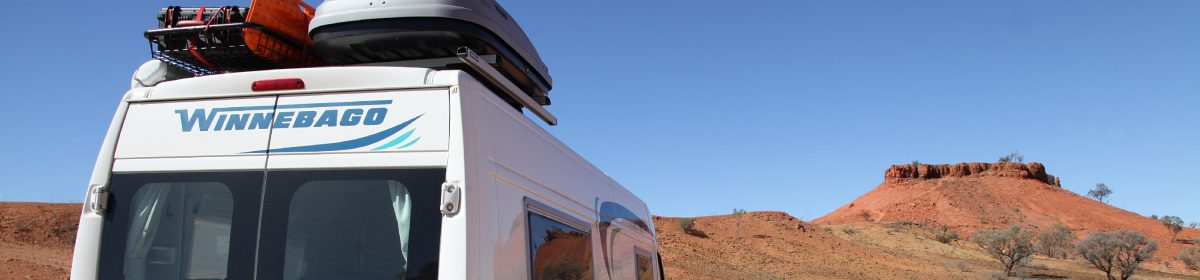
The Stuart and Lasseter Highways

The Stuart Highway between Adelaide and Darwin is called The Explorers’ Way and it largely follows the route of John McDouall Stuart, the first man to successfully cross Australia from the South to the North.  He appears to have been blessed with more common sense than Burke and Wills.

When you’re heading for the centre of the centre of Australia, even if it is on a very good sealed road, it’s a little nerve-wracking.  There’s a whole lot of nothing, phone reception if you’re lucky, a handful of roadhouses selling fuel, very little drinking water, dingoes, oh yes … and billions of flies.  Here’s a little guide to the places we stopped at after Coober Pedy.

Marla Roadhouse (220km)

Fuel and a well stocked supermarket with reasonable prices.  Camping – $10 per person and an extra $10 for power.  Bore water which isn’t drinkable.  Good amenities.  Most of the grass is nice, some three corner jacks (see Peterborough post) to watch out for.

Marla Roadhouse – we broke out the fly net.


110km further on is the Northern Territory border.

The Northern Territory border.

Erldunda Roadhouse (200km)

At the junction of the Lasseter Highway which takes you to Uluru.

A popular stopping off point for tour buses and travellers and this might explain the exorbitant prices for fuel and groceries.  It does have probably the best grass we’ll see in the Outback and Winston took every opportunity to have a roll.  A powered site was $32.  Good amenities.  No drinking water.  Winston saw his first emu at their emu farm.


Curtin Springs Station

Halfway between Erldunda and Uluru.  $40 for power, very basic amenities, showers cost $3.  We decided to camp unpowered which was free.  They have a restaurant and small bar and also run paper making workshops.  From what I can gather, the paper is made out of spinifex and poo.  This cattle station is over a million acres and has sitting on its land, a mountain that’s bigger than Uluru, called Mt Conner.  The only way you can get close to it is on a very expensive tour.


Being a teacher, I desperately wanted to correct the spelling and punctuation mistakes in their signage.
Winston is loving the Outback sand.

Going Underground …

… in Coober Pedy, Outback South Australia.

About 50% of residents live underground in Coober Pedy to escape the heat and their houses are a constant 25 degrees. You can see the air vents poking out of the hillsides.   Staying in an underground hotel was listed as a must do experience and there were a couple of underground motels that allowed dogs.  So we decided to have a break from the van for a couple of nights and booked into the Comfort Inn.  The ceilings have upside down umbrellas suspended below the air shafts to catch any debris falling through.  Winston couldn’t believe his luck when he was allowed in to the motel. The owners have a Cavoodle called Winston too and they were instantly great mates.

Most of the residents of Coober Pedy are opal miners which comes in handy for digging an underground house.  The Old Timer’s Mine had a great tour and a museum.  I also bought a pair of beautiful opal earrings from one of the many jewellers in the town.

All in all an amazing town to experience but not live in!


Australian Arid Lands Botanic Garden, Port Augusta

A top tip is to do a guided tour around this Botanic Garden before travelling north to Alice Springs, to learn all about the plants you will see on the journey.  I was the only one booked on the tour and a lovely lady called Chris Nayda showed me around.  They recently had a year’s rainfall in two days and, combined with the fact that the local MP is visiting tomorrow, the gardens were looking spectacular.


Adelaide

We’re now in Adelaide for the first time, staying at Windsor Gardens caravan park just on the outskirts.  Weatherwise, it’s been a bit of a mixed bag.  The first day we visited Port Adelaide and had beautiful sunshine.

Largs Bay – very pet friendly.  Winston is pleased to see sand again.

The next day it was cold with a biting wind. I’m reliably informed that Adelaide is freezing in winter as the winds gust in from the Antarctic.

We had a good look around the city which is very elegant and spacious.

The Central Market is a must see.  It’s huge, with hundreds of food stalls and produce from all across South Australia.

Adelaide Hills

The town of Hahndorf was originally a German settlement and it still has a strong German feel which makes it a very popular tourist destination.  You can buy German pastries, German meats, cuckoo clocks and souvenirs along the main street.  Everywhere was looking very autumnal.

Hahndorf
Café Assiette, Hahndorf. The sausage platter lasted us for dinner and breakfast the next morning.

The only downside is that with its narrow streets, Hahndorf isn’t really motorhome friendly.


The Barossa

We couldn’t visit the Barossa without calling into the Jacobs Creek Visitor Centre.  It’s a beautiful setting and they certainly make it easy for you to sit and relax, with beanbags on the lawn, overlooking the vineyards.  You can also learn about the history of the winery and walk along the famous creek.

As well as all the famous wine names, Barossa is foodie heaven.  Maggie Beer’s farm shop is just outside Nuriootpa.  For overseas readers, Maggie Beer is Australian cookery royalty.  There is a huge quince orchard at the farm.  It seems that quince trees thrive in South Australia even when neglected but no-one knows what to do with them apart from making quince jelly.  We bought a jar from a farmers’ market but it would have been better used as sealant.  Maggie Beer has developed quite a few recipes including her famous quince paste.  There is an interview with Maggie in the current issue of the Australian Women’s Weekly.  It was a very interesting path that led her to where she is now.

Our Barossa feast: Penfolds Father Tawny Port.  Garlic metwurst from Linke’s Meat Store in Nuriootpa, a selection of cheeses from the Barossa Valley Cheese Company in Angaston, Maggie Beer’s pheasant pate and Barossa Bark crispbread.

Barossa Vintage Festival

A celebration of the region’s wine, food, culture and heritage.  Watching the parade in Nuriootpa:

Then an afternoon of music and Barossa food and wine on the Nuriootpa Oval, followed by a stagger back to the campsite next door!

Each town has their day in the spotlight.

The Lyndoch ‘Feast, Folk and Fossick’ celebration.  They know how to lay on a bbq.
On the right hand side is the queue for the meat

The Clare Valley, SA

We stayed in the town of Auburn as our base for exploring the Clare Valley.  There are several walking trails to choose from including the Riesling Trail to the North and the Rattler Trail to the south, and also a walk through the historic town.  Many of its stone buildings are National Trust listed.  It was nice to see all the autumnal colours of the trees which we don’t get in Brisbane.

There are many cellar doors to choose from.  The Sevenhill vineyard is a must-see. It was established by the Jesuits in 1851 and originally produced altar wine.  Visitors can go on a guided or self walking tour of the winery and grounds, visit the museum and sample wines at the cellar door.

The area is also full of olive groves so you are spoilt for choice when it comes to gourmet olives and olive oils.

Historic rail country (2)

As it’s now school holiday time in South Australia, it was great to find a quiet free camp just south of Peterborough.  For almost 90 years from 1880, Terowie was on the main line from Adelaide to Port Augusta.  Passengers and freight had to stop at Terowie and change trains as it was the ‘break of gauge’ point where the broad and narrow gauges met.  We followed Bob the Railway Dog’s interpretative trail along the old railway line from the restored railway station to the cemetery.

During WWII, there was an Army staging camp in the town.  General Douglas MacArthur made his famous “I shall return” speech on the railway platform in March 1942.

The station closed down in 1989 and the town is largely deserted now.  The Terowie Citizens Association are doing their best to keep the history of the town alive and have restored several buildings.

Terowie main street.

Historic rail country (1)

It was a long drive from Broken Hill, with little to break the journey and we planned to stay at the RV park when we reached Peterborough.  However, there was no shade, it was dusty and full of spiky Three Corner Jacks (also known as the Devil’s Thorn so you get how painful they are). We had a walk round town to stretch our legs before a re-plan and took a look in at the Town Carriage Museum.  This turned out to be great fun as there was a virtual ride aboard a restored first class sleeping carriage from the early 1900’s.

There is a statue of Bob the railway dog nearby.  Bob was a familiar sight to passengers at the end of the 19th century as he loved to ride the trains. Apparently when he died in 1895, he was ‘mourned by the travelling public all over Australia.’

As a bonus we saw the Indian Pacific pass by.  This is a passenger train which travels from Sydney to Perth through the Blue Mountains and across the Nullarbor Plain.


Border crossing

The NSW/South Australia border is 50km from Broken Hill.

South Australia is the only Australian mainland state that is fruit fly free and if you are carrying fresh fruit, you need to either eat it or bin it before crossing the border.  An official had to check inside our van at the inspection point.